
Introduction - Why Go Beyond MVC?
Most Backend Development begin with the MVC (Model-View-Controller) architecture. It’s simple, effective for small projects, and easy to understand. However, as soon as an application grows in complexity—like handling multiple business rules, evolving customer requirements, or scaling for enterprise needs—MVC starts to show its limitations.
Challenges with MVC in complex systems :
- Bloated models : Database models end up holding both persistence and business logic, making them hard to maintain.
- Fat controllers : Controllers often carry too much business logic, reducing reusability.
- Tight Coupling to Database : ORM entities double as business objects, meaning schema changes ripple through your entire application.
- Poor Testability: Testing business logic requires spinning up databases because it's tightly coupled to persistence.
This is where Domain-Driven Design (DDD) shines. instead of organizing code around database tables or API endpoints, you organize around business concepts. The database becomes an implementation detail, not the foundation.
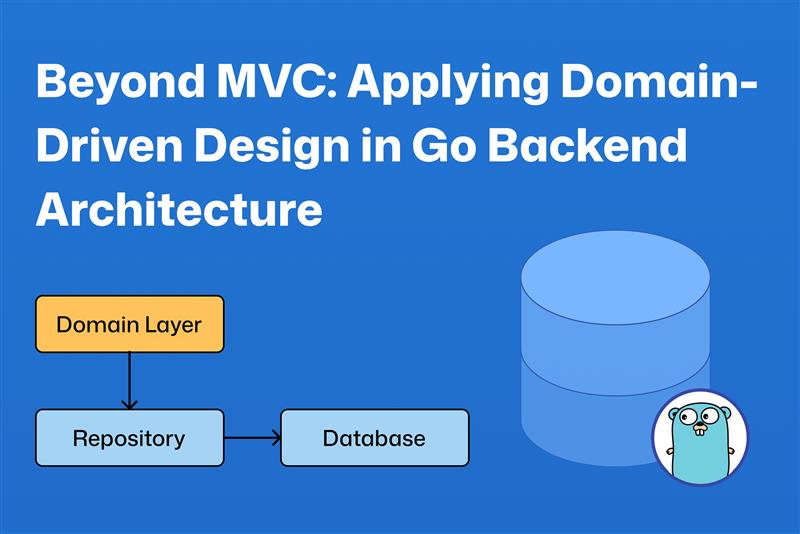
- Domain Layer: Contains the core business rules, including entities, value objects, and domain-specific logic.
- Application Layer : Orchestrates business workflows, executes use cases, and manages transactions.
- Interface Layer : Handles client communication via APIs, web interfaces, or external requests.
- Infrastructure Layer : Implements technical details such as database operations and third-party services.
A DDD-based Go project typically adopts a four-layered directory structure:
go-app/
├── cmd/
│ └── main.go
├── internal/
│ ├── application/
│ │ └── services/
│ │ └── user_service.go
│ ├── domain/
│ │ ├── order/
│ │ │ └── user.go
│ │ └── repository/
│ │ ├── repository.go
│ │ └── user_repository.go
│ ├── infrastructure/
│ │ └── repository/
│ │ └── user_repository_impl.go
│ └── interfaces/
│ ├── handlers/
│ │ └── user_handler.go
│ └── routes/
│ ├── router.go
│ └── user-routes.go
│ └── user-routes-test.go
│ └── middleware/
│ └── logging.go
│ └── config/
│ └── server_config.go
├── pkg/
│ └── utils/
The Shift in Thinking :
In MVC, you ask: "What tables do I need?"
In DDD, you ask: "What are the business rules and how do they interact?"
The database schema becomes a consequence of your domain model, not its driver
DDD Implementation and Best Practices -
1. Domain Modeling
Defines core business entities like User, capturing identity and essential attributes that represent real-world concepts within the domain.
type User struct {
ID int
Name string
}
2. Layered Structure
- Domain Layer : Encapsulates core business rules and defines essential interfaces.
- Application Layer : Coordinates use cases, workflows, and business operations.
- Infrastructure Layer : Manages technical concerns like database, caching, and integrations.
- Interface Layer : Provides endpoints and routes for external communication.
3. Dependency Inversion
The domain layer relies solely on abstractions rather than concrete infrastructure implementations, promoting loose coupling and easier testing.
4. Aggregate Management:
Aggregate roots control the lifecycle and maintain consistency of associated entities.
5. Application Services:
Encapsulate business logic to prevent external layers from directly modifying domain objects.
6. Event-Driven Design:
Leverage domain events and pub/sub mechanisms to enable decoupling and asynchronous workflows.
7. CQRS Integration:
Divide write (command) and read (query) operations to improve scalability and maintain clear separation of concerns.
When to Use DDD
A. Use DDD when:
- Complex business rules that change frequently
- Multiple workflows that interact
- Long-term project with evolving requirements
- Domain experts are available to collaborate
B. Skip DDD for:
- Simple CRUD applications
- Prototypes or MVPs
- Projects with minimal business logic
Conclusion :
DDD isn't about perfect architecture—it's about modeling software that reflects how the business actually works. By separating business logic from infrastructure concerns, you create systems that are testable, maintainable, and aligned with business needs.
Start with one aggregate in your most complex module. As you see the benefits—clearer code, easier testing, better conversations with stakeholders—expand to other areas. With proper layering, we can build applications that grow with business, not against it.